The most common mistake we see in Sudbury is treating the rock mass as a uniform block. A contractor will specify a standard anchor bond length, only to hit a deeply weathered fracture zone in the norite that halves the pull-out capacity. The Sudbury Basin isn't just hard rock—it's a complex mosaic of igneous and metamorphic formations altered by billions of years of meteorite impact and glacial scouring. Designing an anchor system here means navigating through diabase dykes, zones of high in-situ stress from the mining legacy, and groundwater that carries acidic drainage in some areas. When a deep excavation project calls for tiebacks, the bond stress values taken from generic tables simply don't apply. Our approach integrates site-specific pull-out tests and a detailed review of the joint orientation from oriented core, ensuring the fixed anchor length sits in competent ground beyond the potential failure wedge. For structures near the dynamic influence of active mining, combining anchor design with excavation monitoring provides real-time data on load transfer and deformation.
In Sudbury’s fractured norite, a passive anchor is a controlled deformation device—its performance depends entirely on the rock mass modulus you assume in the design phase.
Our approach and scope
Site-specific factors
Sudbury’s continental climate swings from minus 30-degree Celsius winters to humid summers, and this thermal cycling is brutal on anchored structures. The freeze-thaw action in the near-surface rock can generate heave pressures that overload passive anchors if the unbonded length wasn't extended deep enough past the frost line. Then there’s the groundwater: in parts of the Valley, perched water tables above the bedrock create artesian conditions during spring melt, dramatically increasing the hydrostatic pressure behind a tied-back wall. A passive system that relies on a slight wall movement to engage the load might deform beyond the serviceability limit before the anchors pick up the full pressure. For active systems, we’ve seen lock-off loads relax by 8 to 10 percent in the first winter as the steel and rock reach thermal equilibrium, a detail that must be anticipated in the stressing sequence. The proximity to active mines also introduces blast-induced vibrations; a sudden dynamic load can cause a brittle failure at the grout-rock interface if the bond stress was pushed too close to the ultimate capacity without a sufficient factor of safety.
Reference standards
CSA A23.3: Design of Concrete Structures (Annex D – Anchors), NBCC 2020 (National Building Code of Canada), PTI DC35.1: Recommendations for Prestressed Rock and Soil Anchors, CSA Z662 (if anchors are near pipeline right-of-ways), ASTM A416 (Grade 270 low-relaxation strand)
Complementary services
Active Tieback Design for Deep Excavations
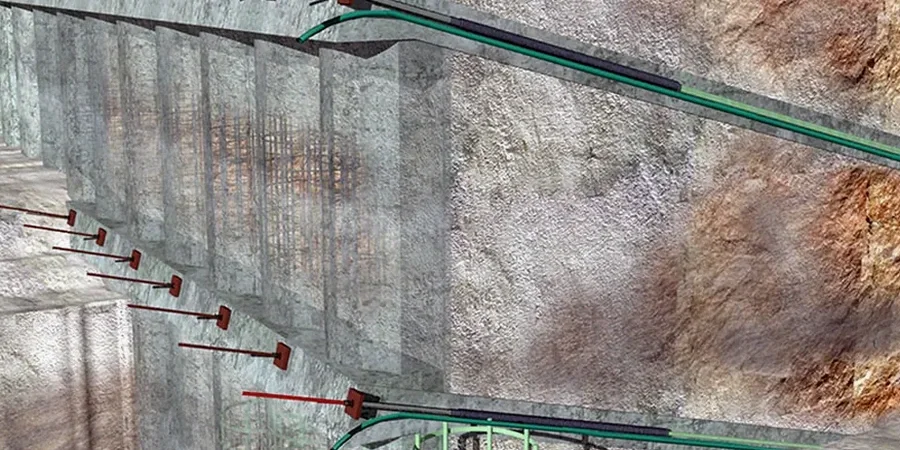
We design prestressed anchors for shoring walls in downtown Sudbury, where space is tight and adjacent structures cannot tolerate movement. The design includes a finite element analysis of the bonded zone, staged stressing sequences, and a lift-off testing program to verify the residual load after lock-off.
Passive Rock Bolt Systems for Slope Stabilization
For rock cuts along Highway 17 or near Ramsey Lake, we design fully grouted passive bars that engage as the rock mass dilates. We map discontinuity sets from LiDAR scans and use limit equilibrium methods to size the bolt pattern, length, and plate capacity.
Anchor Corrosion Evaluation and Remedial Design
Given Sudbury's industrial history, many existing anchors suffer from sulfide-induced corrosion. We conduct half-cell potential surveys, extract samples for metallurgical analysis, and design replacement anchors with enhanced encapsulation details and cathodic protection where necessary.
Typical parameters
Frequently asked questions
What’s the typical cost range for an anchor design package in Sudbury?
A complete design package for a permanent anchored wall or slope stabilization in Sudbury typically runs between CA$1,550 and CA$4,620, depending on the number of anchor rows, the corrosion protection class required, and the extent of the pull-out test program. A simple temporary shoring design with a single row of active anchors falls at the lower end, while a multi-row permanent system with full documentation and construction support sits at the upper range.
How do you determine the bond stress for anchors in Sudbury’s norite?
We don’t rely on textbook values. The bond stress is established through a site-specific pre-production pull-out test program on sacrificial anchors installed with the same drilling method and grout mix as the production anchors. We test to failure and apply a factor of safety of at least 2.0 on the ultimate bond stress, per PTI recommendations. In fractured norite, the governing failure mode is often the rock mass shear strength around the grout column, not the grout-strand interface.
What’s the difference between an active and a passive anchor for a retaining wall?
An active anchor is prestressed during installation to apply a known compressive force to the wall, immediately locking the structure in place. A passive anchor is not stressed; it only develops resistance when the wall moves and the tendon elongates. In Sudbury, we recommend active systems for most permanent walls because the immediate lock-off eliminates the initial deformation and gives you a testable, verifiable load. Passive systems are more common in temporary rock bolt applications or where access for stressing jacks is impossible.
Do you need to consider mining-induced seismicity in the anchor design?
Yes, in certain parts of the Sudbury Basin within the influence zone of active stopes, we incorporate a dynamic load factor into the design. The anchor must have sufficient ductility to absorb a sudden impulse without brittle fracture. We often specify a higher elongation capacity and avoid rigid, fully restrained systems in these zones. The seismic demand is coordinated with the mine’s ground control engineer and checked against the NBCC seismic provisions for the site class.