Sudbury sits in a moderate seismic zone, but what really keeps engineers up at night isn't just the shaking—it's the ground beneath. The Sudbury Basin, formed by a massive meteorite impact nearly two billion years ago, left a geological fingerprint of fractured norite, granophyre, and deep overburden that behaves unpredictably during a seismic event. For any significant structure here, standard rigid-base design can pass code on paper while still exposing the building to costly damage. Our team integrates seismic microzonation studies to map how those local rock fractures and soil pockets actually amplify ground motion, which directly informs the base isolation parameters. This isn't about over-engineering; it's about aligning the building's fundamental period with the real site response, not a generic spectrum. When you couple that with a CPT test to nail down the shear wave velocity profile through the overburden, you get a design basis that makes financial sense—lower ductility demands on the superstructure, reduced drift, and a building that stays operational after the design earthquake.
In Sudbury, base isolation turns the Basin's fractured bedrock from a liability into a design parameter you can actually work with.
Our approach and scope
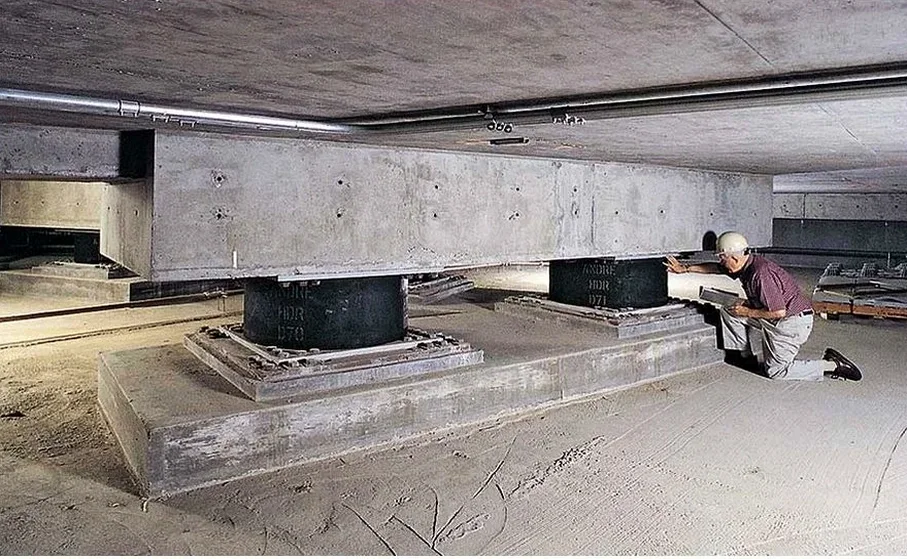
Site-specific factors
Sudbury's expansion from a mining camp into a regional hub means a lot of mid-rise buildings went up on compacted mine tailings or fill over the Basin's irregular rockhead. Those older structures are fixed-base and stiff—they'll attract high seismic forces while sitting on ground that can differentially settle or amplify short-period motion. A new build or major retrofit without isolation inherits that same vulnerability. The biggest risk isn't collapse; it's a moderate quake that leaves the building standing but with cracked partitions, jammed doors, and fractured sprinkler lines, triggering a six-figure repair and months of downtime. Base isolation cuts that damage probability by decoupling the structure from ground motion entirely. The cost-benefit equation shifts even more when you consider Sudbury's role as a critical service center for northeastern Ontario—a hospital or emergency operations center here can't afford to be non-functional after a seismic event.
Reference standards
NBCC 2020 (National Building Code of Canada, seismic provisions), CSA A23.3:19 (Design of concrete structures, ductility and anchorage requirements), CSA S6-19 (Canadian Highway Bridge Design Code, seismic isolation chapter), ISO 22762 (Elastomeric seismic-protection isolators)
Complementary services
Site-Specific Seismic Hazard & Isolation Design
We develop the design basis earthquake and isolation parameters using NBCC 2020 and site-specific response analysis for the Sudbury Basin's unique geology. This includes the full nonlinear time-history analysis, isolator specification, and peer review coordination.
Isolation Interface & Moat Detailing
Detailed design of the isolation plane, including utility crossings, moat walls, and stair/elevator transitions that accommodate the design displacement. We coordinate closely with the structural and MEP teams to ensure no hard points bypass the isolation system.
Typical parameters
Frequently asked questions
What does base isolation seismic design typically cost for a building in Sudbury?
For a mid-rise commercial or institutional building in Sudbury, the combined site characterization and isolation design services generally fall between CA$5,380 and CA$9,960, depending on the number of isolators and the complexity of the site-specific response analysis. This covers the complete design package—spectral analysis, isolator specification, moat detailing, and construction support.
How does base isolation handle Sudbury's freeze-thaw cycles?
The isolators sit below the frost line in a conditioned or ventilated pit. We specify bearing compounds rated for low-temperature stiffness stability and detail the inspection pit drainage to prevent ice lensing around the pedestals. The moat cover and flexible utility connections are designed for snow load and ice buildup without restricting the seismic gap.
Can existing buildings in Sudbury be retrofitted with base isolation?
Yes, though it's more common for high-value heritage or critical infrastructure. The process involves temporarily shoring the building, cutting columns at the isolation plane, and inserting isolators—one column at a time. It's technically demanding and requires careful phasing, but we've done the engineering for several retrofit projects across Ontario. The key is a thorough condition assessment of the existing foundations first.