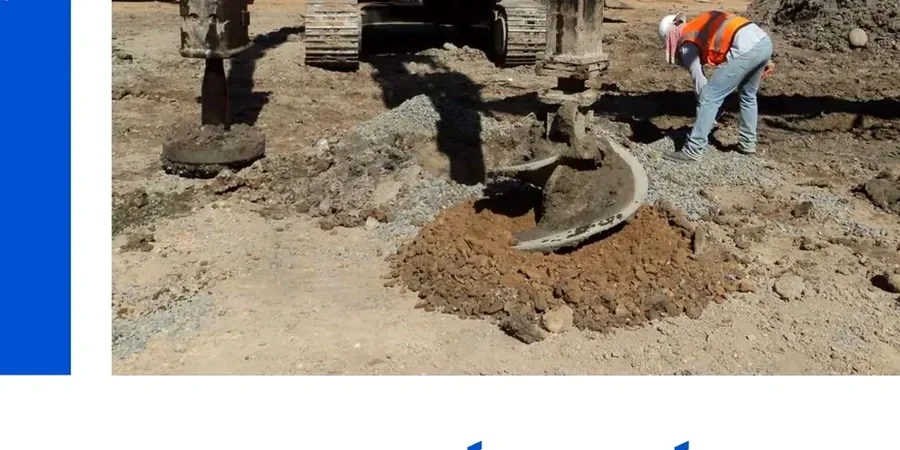
The rig is a top-feed vibroflot mounted on a crawler base, with a 130 kW hydraulic power pack. In Sudbury we run it through dense glacial till overlying soft varved clays—typical of the post-glacial lake deposits around the Ramsey Lake basin. The vibrator displaces the weak matrix and creates a compacted aggregate column from the bottom up. Feed rates are adjusted continuously based on amperage draw and stone consumption per linear metre. Sudbury’s geology, shaped by the 1.85-billion-year-old impact structure, often hides pockets of decomposed bedrock and abrupt transitions that demand real-time parameter control during column installation. Before mobilizing the vibro rig, we commonly correlate the design parameters with data from an SPT drilling program to confirm refusal depth and lateral variability across the footprint of the structure.
The composite ground improvement factor in Sudbury’s layered glacial sequence can exceed 2.5 when columns are properly socketed into the till.
Our approach and scope
Site-specific factors
Sudbury’s winter frost penetration, which can exceed 1.8 m according to the Ontario Building Code, introduces a freeze-thaw cycle that affects stone column performance if not properly addressed in the design. The top portion of the column must be isolated from frost heave through a granular cap or a rigid load transfer platform. Another factor we monitor closely is the presence of acidic groundwater near former mining operations: low pH can degrade certain carbonate-based aggregates over time. On sites near Vermilion River and its tributaries, the water table sits high year-round, meaning column installation is done with water flush and the backfill receives additional fines control to avoid clogging the drainage path. The interaction between the stone column and the surrounding sensitive clay requires careful estimation of radial drainage and consolidation time, particularly when the project schedule demands early loading of the foundation.
Reference standards
NBCC 2020 (National Building Code of Canada), CSA A23.3-19 (Design of Concrete Structures – aggregate properties), ASTM D4718-15 (Oversize correction in compaction), Ontario Building Code (frost depth and foundation requirements)
Complementary services
Design of aggregate pier grids
We define column diameter, spacing, depth and the load transfer platform based on the allowable settlement and bearing pressure required for the structure. The design includes liquefaction mitigation checks when loose silts are present within the treatment zone.
Field quality control and modulus verification
During installation we track amperage, stone volume per lift and penetration rate. After curing, we run plate load tests on selected columns and cross-hole seismic tests between columns to confirm the composite shear wave velocity meets the design target.
Typical parameters
Frequently asked questions
What types of structures in Sudbury benefit most from stone columns?
Warehouses, commercial buildings, bridge approaches and storage tanks on soft compressible soils. In the Sudbury basin, ground improvement with stone columns works well where the bearing stratum is within 10 to 15 metres and the site cannot accommodate deep foundations due to cost or access constraints.
How long does stone column installation take?
A typical rig can install 200 to 350 lineal metres per shift depending on depth and soil resistance. For a commercial building footprint in Sudbury with 120 columns at 6 m average depth, installation usually takes four to six working days, followed by plate load testing.
How much does a stone column design cost?
The design package, including geotechnical analysis, grid layout, settlement calculations and construction specifications, ranges from CA$1,830 to CA$6,730 depending on the complexity of the soil profile and the number of load cases to verify.
Can stone columns be installed through fill material?
Yes, but the fill must be free of large boulders and demolition debris that could damage the vibrator. In Sudbury we often encounter historical slag fill near former rail yards. We recommend probe drilling through the fill layer before committing to a column grid to identify obstructions that would require pre-drilling.