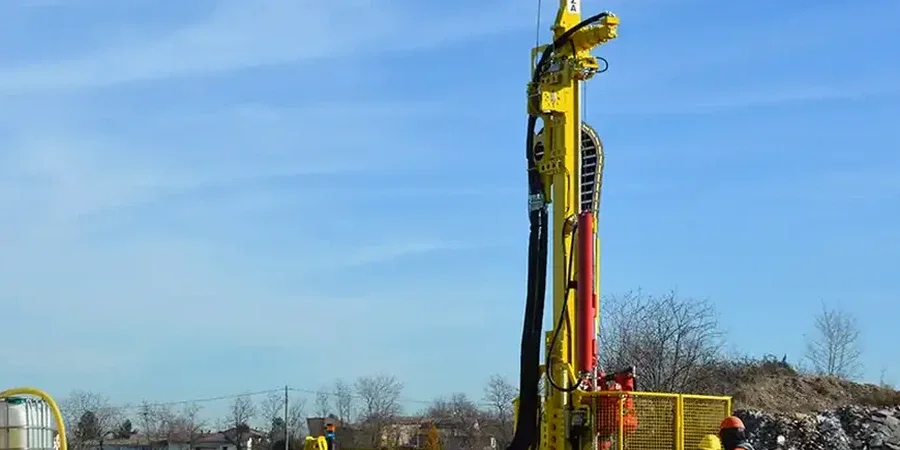
A 140-pound safety hammer dropping 30 inches onto the drill rods—that rhythmic thud is the sound of an SPT test in progress. In Sudbury, where the overburden can shift from dense basal till to loose glaciofluvial sand within a few meters, that repetitive impact tells you a lot about what’s underneath. Our rigs work across the Sudbury Basin, from the clay pockets near Kelly Lake to the sandy ridges in Garson, extracting split-spoon samples at every 5-foot interval. Clients get more than just a boring log. They get a feel for the ground before a single excavator bucket breaks the surface. For deeper profiling in soft zones, we often pair the SPT with a CPT test to capture continuous tip resistance and pore pressure data without sample disturbance.
In Sudbury's glacially disturbed terrain, a single SPT refusal at shallow depth can change a foundation design from spread footings to micropiles overnight.
Our approach and scope
Site-specific factors
Sudbury’s expansion through the mid-20th century saw neighborhoods built quickly on compacted fill and mine tailings, particularly in areas like Copper Cliff and the West End. Today, redevelopment on those parcels carries real risk. Loose fill or undocumented backfill can produce SPT N-values below 5—a red flag for any foundation engineer. Skipping the subsurface investigation means gambling on differential settlement, and in a region with 150 frost days a year, freeze-thaw cycles will exploit every weak pocket. An SPT program identifies these soft spots early, before concrete is poured. The data lets the structural engineer adjust footing sizes, specify ground improvement like stone columns, or recommend a deep foundation system that reaches competent till or bedrock. In Sudbury, where bedrock can also be irregular and steeply dipping, knowing refusal depth at multiple locations prevents costly construction surprises and keeps the project on schedule.
Reference standards
CSA A23.3 – Design of concrete structures (reference for geotechnical parameters), NBCC 2020 – National Building Code of Canada (Section 4.2: Foundations), ASTM D1586 – Standard Test Method for Standard Penetration Test (SPT) and Split-Barrel Sampling of Soils, CSA A660 – Certification of manufacturers of steel building systems (foundation requirements), OPSS 206 – Ontario Provincial Standard Specification for Geotechnical Investigation
Complementary services
Subsurface Investigation & Logging
Full-service SPT drilling with split-spoon sampling, field classification by an experienced technician, and sample transport to our CSA-certified lab for index testing. We handle the Ministry of Labour drill rig notification so you don't have to.
Foundation Design Parameters Package
We deliver corrected N60 profiles, soil unit weight estimates, friction angle correlations, and presumptive bearing capacity ranges. The report includes bedrock refusal mapping across all boreholes, critical for Sudbury projects where rock surface dips unpredictably.
Typical parameters
Frequently asked questions
How much does an SPT investigation cost in Sudbury?
A typical single-family residential program with two to three boreholes to 15–20 meters depth runs between CA$840 and CA$1,100 per borehole, depending on access, ground conditions, and whether bedrock coring is required. Commercial projects with deeper holes and more extensive sampling are priced by the meter after the first borehole. We provide a fixed-price proposal after reviewing the site plan and any existing geotechnical records from the Sudbury area.
How deep do you typically drill for an SPT in Sudbury?
Depth depends on the foundation type and the site's surficial geology. For spread footings on residential lots, we usually go to 12–15 meters or until refusal on competent bedrock, whichever comes first. In deeper overburden zones like the Valley East area, boreholes may extend to 25 meters. Ontario Building Code requires investigation to a depth where the net stress increase is less than 10% of the applied load, and our drillers follow that criterion on every hole.
What’s the difference between SPT and CPT for my Sudbury project?
SPT recovers a physical soil sample every 1.5 meters, which lets us visually classify the soil and run lab tests like grain size or Atterberg limits. CPT pushes a cone continuously and records tip resistance and sleeve friction without sampling. In Sudbury, where gravelly tills and boulders are common, SPT is more practical—the split spoon can break through obstructions that would stop a CPT cone. For soft clay or loose sand sites, CPT gives a higher-resolution profile, and we often recommend both.
How long does the fieldwork take and when will I get the report?
For a standard two-borehole residential program, the drilling crew is on site for one day. A five-borehole commercial investigation typically takes two to three days. The geotechnical report—with boring logs, N60 profiles, lab results, and foundation recommendations—is delivered within 10 to 14 business days after field completion. Rush turnaround is available for projects facing tight construction schedules.