Sudbury's compacted fills sit on a unique blend of glaciolacustrine clays and the rugged outcrops of the Canadian Shield. The contact between these materials is sharp—skip density control at your own risk. We run the sand cone test across Chelmsford, Copper Cliff, and Garson subdivisions, verifying compaction on silty sand backfill that contractors place around basement footings and utility trenches. The standard here is the National Building Code of Canada, backed by ASTM D1556 and CSA A23.3 requirements for granular placement. A test pit investigation lets us inspect the native subgrade before fill starts, while CBR testing confirms the structural capacity of the pavement section above the compacted layers.
A sand cone test takes fifteen minutes on site, but the difference between 95% and 92% compaction can mean settlement in the first freeze-thaw cycle.
Our approach and scope
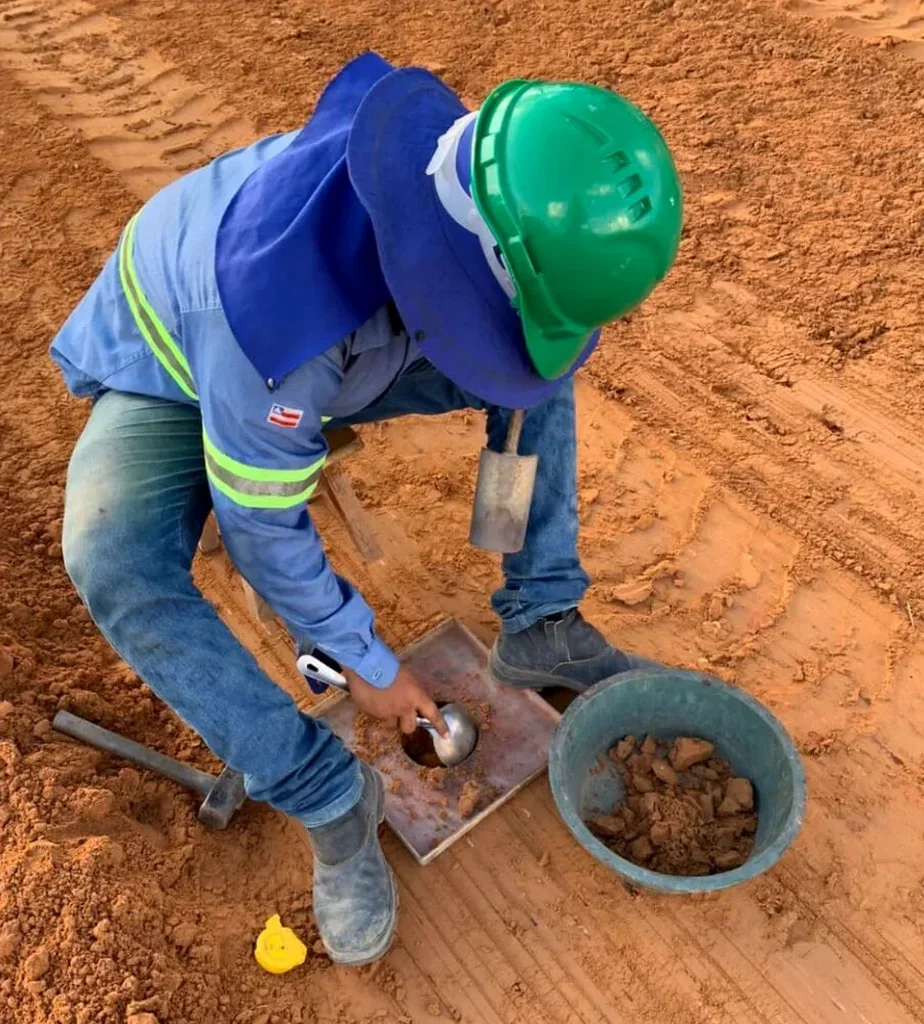
Site-specific factors
We've pulled sand cone samples in Sudbury where the fill looked solid from the surface but the bottom of the hole revealed cobbles and voids from frozen lumps placed in January. That's a problem because the density reading gets falsely elevated by the oversize fraction. ASTM D1556 requires careful correction when retained material exceeds 15% on the 19 mm sieve, but many operators ignore it. Another risk is moisture migration: compacted clay fill placed near bedrock outcrops can dry out on one side and stay saturated on the other, creating differential heave. Without a density log that ties each lift to its moisture condition, the contractor has no defense when cracks appear in the slab. We always recommend correlating sand cone results with a nuclear gauge cross-check on large-area fills to catch inconsistencies before the next lift goes down.
Reference standards
ASTM D1556 - Standard Test Method for Density and Unit Weight of Soil in Place by Sand-Cone Method, ASTM D698 - Standard Test Methods for Laboratory Compaction Characteristics of Soil Using Standard Effort, NBCC - National Building Code of Canada (Soil and Foundation provisions), CSA A23.3 - Design of Concrete Structures (compacted fill support requirements), OPSS.MUNI 501 - Ontario Provincial Standard Specification for Compacting
Complementary services
Standard Proctor (ASTM D698)
We run the laboratory compaction curve on your borrow material so the field sand cone result has a valid maximum dry density reference.
Field Density by Sand Cone (ASTM D1556)
On-site testing with calibrated Ottawa sand. We dig, weigh, and measure moisture content for each lift. Results are reported same-day.
Compaction Inspection and Logging
We track lift-by-lift density across the fill area, flagging low-density zones before they get buried under the next layer.
Nuclear Gauge Correlation (ASTM D6938)
For large-area fills, we correlate sand cone spot checks with nuclear gauge readings to speed up production without losing accuracy.
Typical parameters
Frequently asked questions
How much does a sand cone density test cost in Sudbury?
A single sand cone test on a residential or light commercial site in Sudbury typically runs between CA$130 and CA$180, depending on travel distance to locations like Lively or Capreol and the number of tests required per visit. We provide a firm quote before mobilizing.
How deep does the sand cone test go?
The test hole depth matches the compacted lift thickness, usually 100 to 150 mm. We don't test deeper than one lift because the result must represent a single placement layer. For thicker fills, we test each lift separately.
Can you test fill that contains large rocks or rubble?
ASTM D1556 works best on soils with maximum particle size under 38 mm. If the fill contains oversize cobbles or shale fragments common in some Sudbury borrow pits, we apply a rock correction factor or switch to a water replacement method for that zone.
How soon do we get the density report after testing?
We send the field density report by end of business day. It includes wet and dry density, relative compaction percentage against the lab proctor, and the moisture content. If the contractor needs an immediate pass/fail on site, we give a verbal result before we leave.