Sudbury sits at 347 meters above sea level, carved into the billion-year-old Sudbury Basin. This isn't standard soil territory; it's the Canadian Shield. When a contractor hits mixed overburden and fractured bedrock at a depth of 1.2 meters on a slope off Regent Street, generic retaining wall designs fail. Our laboratory team runs the numbers on the actual fill: we test the backfill gradation under ASTM D422 and the shear strength of the native glacial till. The result is a retaining wall design that works with the lateral earth pressure, not against it. We see a lot of gabion and cantilever walls in the area, and the common failure point is always the interface between the engineered fill and the natural ground. We combine the wall design with a slope stability analysis to check global failure surfaces before a single block is placed.
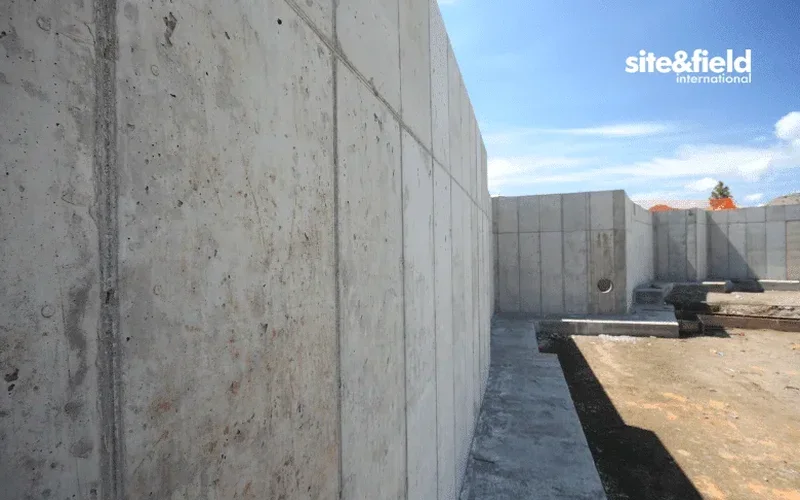
A retaining wall in Sudbury must handle two loads: the static earth pressure and the dynamic frost jacking of fractured bedrock.
Our approach and scope
Site-specific factors
The South End and the Valley East area are geotechnically different worlds. The South End often sits on thick glaciofluvial sands that drain well but have low cohesion; walls here risk sliding at the base if the passive resistance at the toe is insufficient. Valley East, on the other hand, has a higher silt content in the matrix, and the water table sits closer to the surface. A wall in Valley East without a proper French drain and a filter fabric separation layer will collapse from hydrostatic buildup behind the stem. The real risk in Sudbury is the rock variability: a fresh norite face has excellent friction, but a weathered or blasted face can have open joints that act as water conduits. If you don't account for the water pressure in the tension crack behind the wall, the overturning moment will exceed the factor of safety.
Reference standards
NBCC 2020 (Part 4), CSA A23.3-19 (Design of Concrete Structures), OPSS.MUNI 206 (Granular Fill), ASTM D422 (Particle-Size Analysis), CHBDC CAN/CSA-S6-19 (Earth Retaining Structures)
Complementary services
Stability and Reinforcement Analysis
We compute the factors of safety for overturning, sliding, and bearing capacity. The output includes the bending moment and shear force envelopes for the stem and heel, checked against the CSA A23.3 strength reduction factors.
Backfill and Drainage Inspection
We test the granular backfill for permeability and freeze-thaw durability. The inspection covers the filter fabric placement, the weeping tile outlet, and the density of the structural fill using a nuclear gauge.
Typical parameters
Frequently asked questions
What is the typical design life of a retaining wall in Sudbury?
We design permanent walls for a 50 to 75-year service life following the Canadian Highway Bridge Design Code (CHBDC) CAN/CSA-S6-19. The durability requirements for concrete exposed to freeze-thaw and de-icing salts are taken from CSA A23.1 Tables 1 and 2.
What is the approximate cost for a retaining wall design in Sudbury?
The fee for a site-specific design package, including the structural calculations and the geotechnical report, typically ranges from CA$1,590 to CA$5,660. The range depends on the wall height and the complexity of the subsurface conditions at your site.
Do I need a geotechnical investigation for a small gravity wall?
Yes, even a small gravity wall requires a basic investigation. We need to confirm the bearing stratum isn't loose fill or organic soil. A shallow test pit and a hand penetrometer test can often provide the data needed for a low-height wall.
How do you handle the fractured rock typical of the Sudbury Basin?
We characterize the rock mass using the Geological Strength Index (GSI) and measure the orientation of the main joint sets. If the joints dip into the excavation, we design a rock anchor system to pin the potential wedge and prevent a plane failure.