The Sudbury Basin's unique impact geology creates sharp velocity contrasts between overburden and fractured Archean basement rock, making seismic tomography the only reliable way to map bedrock depth before excavation. With over 1.6 million residents across the Greater Sudbury region and a frost penetration depth reaching 1.8 meters in the Canadian Shield, the near-surface conditions demand more than just a drilling program. Our field crews deploy 24-channel and 48-channel arrays to run both P-wave refraction and high-resolution reflection lines, delivering continuous 2D velocity sections that tie directly to NBCC seismic site class determinations. When the target is deeper than 30 meters or masked by a high-velocity caprock layer, we combine the MASW survey for shear-wave velocity profiling, ensuring the Vs30 calculation isn't biased by a hidden low-velocity zone.
Intercepting a 10-meter-deep trough in the bedrock with a refraction line costs a fraction of what a single day of unplanned hammering costs the contractor.
Our approach and scope
Site-specific factors
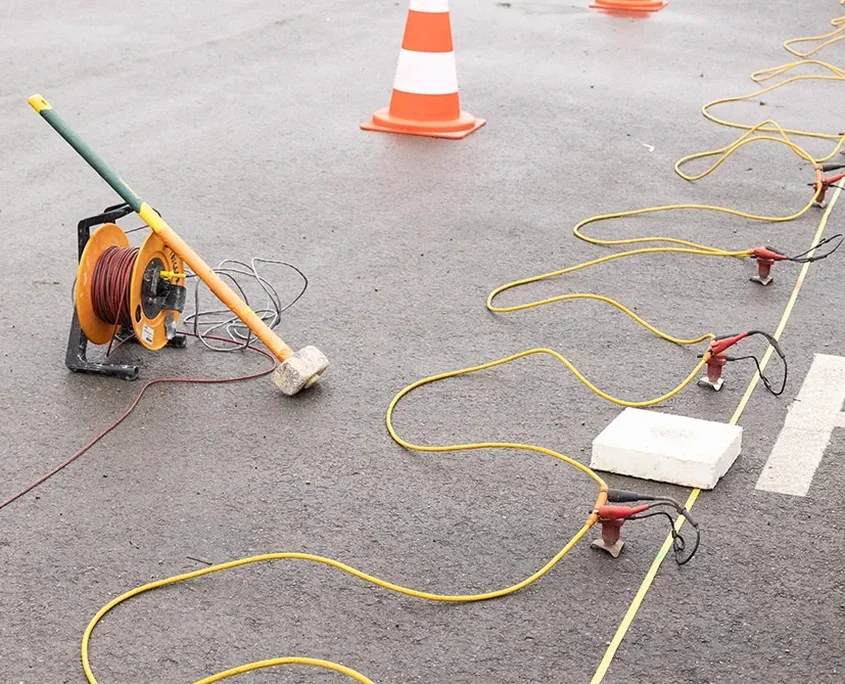
A 48-channel Geometrics Geode seismograph with a 24-bit A/D converter forms the core of our Sudbury field kit, chosen specifically for its dynamic range when recording in the electrically noisy environment near active mining operations and the smelter complex. The biggest technical risk in a refraction survey isn't the equipment but the hidden velocity inversion layer: a stiff clay beneath loose sand will look like bedrock on the time-distance curve, leading to an overestimate of refusal depth. We catch this by running a short reflection spread over the same line or by checking the intercept time against a known bedrock outcrop nearby. Skipping this cross-check in the Chelmsford or Val Caron areas, where glaciolacustrine clays can be overconsolidated to 200 kPa, has led to foundation redesigns mid-project. The raw shot gathers are always inspected for air-blast and power-line noise before any automatic picking routine is applied.
Reference standards
NBCC 2020 Seismic Site Classification (Vs30), CSA A23.3-14 Design of Concrete Structures (seismic provisions), ASTM D5777-18 Standard Guide for Seismic Refraction, ASTM D7128-18 Standard Guide for Seismic Reflection
Complementary services
P-Wave Refraction Tomography
2D velocity profiling for bedrock depth, rippability assessment, and overburden characterization using 24- or 48-channel spreads with 2- to 5-meter geophone spacing.
High-Resolution Seismic Reflection
Shallow reflection surveys targeting stratigraphic boundaries, fracture zones, and abandoned mine openings within the top 80 meters of the Sudbury Basin rock mass.
Vs30 Site Classification Surveys
Combined refraction and MASW acquisition to determine the average shear-wave velocity in the upper 30 meters, delivering the NBCC site class for structural design.
Typical parameters
Frequently asked questions
How deep can seismic refraction see in the Sudbury Basin?
With a 48-channel spread and 5-meter geophone spacing, a refraction survey in the Sudbury Basin typically reaches depths of 25 to 40 meters. The actual depth depends on the velocity contrast: the norite and granite bedrock here generates a strong refractor, but the irregular surface topography of the rockhead can limit penetration in areas like Garson or Copper Cliff where the overburden is thin and the bedrock is highly fractured.
What does a seismic tomography survey cost for a residential lot in Sudbury?
A residential-scale refraction survey on a single lot in the Greater Sudbury area, including mobilization, one to two 48-meter lines, data processing and a signed report, generally ranges from CA$3,220 to CA$7,660. The final figure depends on the number of linear meters, the accessibility of the terrain, and whether a reflection overlay is required to resolve a suspected velocity inversion.
Can seismic reflection detect old mine workings before we excavate?
Yes, high-resolution seismic reflection with 100 Hz geophones can often image voids and collapsed zones within the bedrock when the target is larger than about 2 meters. The Sudbury Basin has thousands of documented and undocumented openings; a reflection line run across a suspected stope or drift can show a disrupted reflector pattern that warrants follow-up with a targeted borehole before any heavy equipment moves onto the pad.
How do you turn seismic velocities into an NBCC site class?
We convert the P-wave velocity model from the refraction survey to shear-wave velocity using Poisson's ratio values calibrated from local borehole data, or we run a parallel MASW line to measure Vs directly. The average Vs in the top 30 meters (Vs30) is then calculated and mapped to a site class from A (hard rock, Vs30 > 1500 m/s) to E (soft soil, Vs30 < 180 m/s) according to Table 4.1.8.4.A of the NBCC 2020. Most sites on the Shield fall into Class B or C, but pockets of deep clay in the Valley East area can drop to Class D. More info.