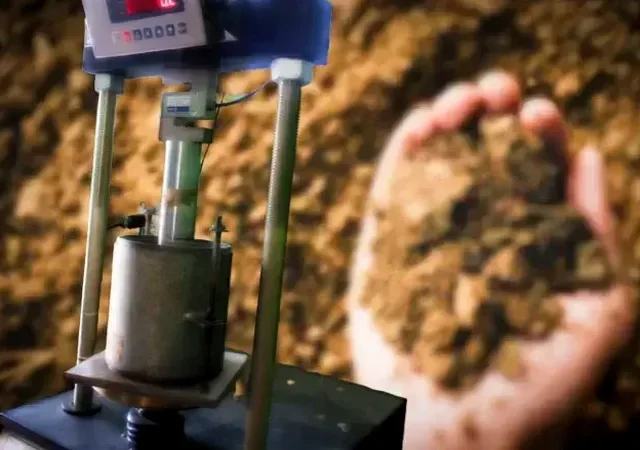
The biggest mistake we see on Sudbury projects is a pavement design based on a borrowed CBR number from a report 200 km away. It doesn't work here. The glacial till south of the city—around the Ramsey Lake basin—can shift from a stiff 20 to a mushy 3 after a heavy spring thaw, and spec'ing the wrong subbase depth off a generic value is a guaranteed way to blow the paving budget with rutting and alligator cracking two seasons in. Our lab runs the soaked California Bearing Ratio test under ASTM D1883, compactive effort matched to the actual field density specified in the contract, so the structural number you plug into the AASHTO 93 equation reflects real post-construction saturation conditions in the Sudbury basin. We also pair the CBR result with a grain size analysis on the same sample—because a CBR of 8 in a well-graded gravel means something very different than a CBR of 8 in a silty sand with 15 percent fines.
A soaked CBR of 5 on Sudbury till demands a completely different pavement section than a dry CBR of 12—and spring thaw doesn't care which one you priced.
Our approach and scope
Every CBR sample that comes through the lab gets logged with its in-situ moisture, dry density, and a visual classification against the USCS, because the number alone doesn't tell the full story.
Site-specific factors
Sudbury's freeze-thaw cycles are brutal on pavement structures in a way that a dry August compaction test never captures. The city averages over 130 freeze-thaw cycles per year—one of the highest counts in Ontario—and each cycle pumps fines up through the granular base if the subgrade CBR drops too low when saturated. The risk materializes in late March, when the top 600 mm of subgrade thaws while the lower layers remain frozen, trapping meltwater and creating a perched water table directly under the asphalt. If the laboratory CBR test was run unsoaked, or the sample wasn't compacted to the actual field density, the pavement section is under-designed by 30 to 50 percent—crack sealing crews know exactly where those spots are on Lasalle Boulevard every April. We run the soaked CBR at the worst-case moisture content because the cost of an extra 100 mm of granular A is trivial compared to a full-depth reconstruction three years post-warranty.
Reference standards
ASTM D1883 – Standard Test Method for California Bearing Ratio (CBR) of Laboratory-Compacted Soils, CSA A23.3 – Design of Concrete Structures (referenced for pavement support requirements), Ontario Provincial Standard Specification OPSS 1010 – Material Specification for Aggregates – Base, Subbase, Select Subgrade, and Backfill Material, ASTM D698 / D1557 – Standard/Modified Proctor Compaction Test (prerequisite for CBR moulding)
Complementary services
Proctor Compaction (Standard & Modified)
We establish the moisture-density relationship on the same material before moulding the CBR specimens. Without a Proctor curve, you're guessing the compaction target—and the CBR number changes dramatically with density.
Grain Size Analysis with Wash
Fines content drives CBR loss during soaking. A full sieve plus hydrometer run tells you whether that CBR of 12 is going to hold or collapse after the first heavy rain.
Atterberg Limits
If the plasticity index is above 15, the soaked CBR is going to be low. We run liquid and plastic limits on the minus 425 µm fraction to flag frost-susceptible subgrades before the pavement design locks in.
Field Density by Nuclear Gauge
Once the pavement section is built, we verify compaction with a nuclear densometer on the subgrade and each lift of granular. The lab CBR only works if the field achieves the density we moulded it at.
Typical parameters
Frequently asked questions
What does a laboratory CBR test cost in Sudbury, and how long does it take?
Budget between CA$180 and CA$250 per point for a standard soaked CBR with Proctor compaction included. That covers moulding at the specified compactive effort, the 96-hour soak, and the penetration test with the load-penetration curve in the report. Standard turnaround is three working days; if you need it faster for a Monday morning tender submission, we can run it on a rush schedule and have the PDF to you in 24 hours. Rush fees are modest—call ahead to confirm the lab queue.
Do you run the CBR test soaked or unsoaked?
We default to soaked unless the spec explicitly calls for unsoaked. In Sudbury, with the freeze-thaw cycles and spring melt we get, a soaked CBR is the only number that matters for pavement design. The sample sits submerged for 96 hours with a surcharge weight simulating the pavement mass, and we measure swell before penetration. If you need both soaked and unsoaked on the same material, we can split the batch and run comparative points.
Can you test field-compacted samples, or do you need loose material?
We can do both. The standard ASTM D1883 procedure starts with loose material that we compact in the lab at a target moisture and density. But if you've got Shelby tubes or block samples from a test pit and you want a CBR on the undisturbed material, we can trim a specimen directly into the CBR mould—this is more common on stiff clay subgrades where you don't want to destroy the natural structure. Just let us know what you're sampling before the field crew goes out.
What's the smallest sample quantity you need to run a CBR test?
For a standard single-point CBR with Proctor, we need about 35 kg of material—roughly two full five-gallon pails. That gives us enough for the Proctor curve plus the CBR mould at the target moisture. If the material is coarse and you want a modified Proctor with a 6-inch mould, bump that to 45 kg. Smaller quantities mean we're guessing on the moisture-density relationship, and a guessed Proctor curve produces a CBR number that nobody should be signing off on.