Sudbury’s transformation from a rugged mining outpost on the Canadian Shield to a modern regional hub left a complex legacy beneath its streets and building sites. The regolith that blankets the bedrock here often contains glacial lake sediments and varved clays deposited during the retreat of the Laurentide Ice Sheet, materials whose behavior hinges on subtle changes in water content. A contractor breaking ground near Ramsey Lake or a developer expanding into the city’s outlying communities quickly discovers that these fine-grained soils do not respond predictably without precise classification. Our laboratory team performs Atterberg limits testing to define the liquid limit, plastic limit, and plasticity index of these sensitive deposits, providing the numerical boundaries that govern excavation stability, compaction specifications, and long-term foundation performance. The transition between solid and plastic states in Sudbury’s lacustrine silts can occur within a moisture range of just a few percentage points, and misjudging that window during a wet spring melt leads to equipment bogging, fill rejection, and costly schedule delays. We complement the index testing program with grain size analysis to distinguish silt-dominated fractions from true clays, and when the project involves cut slopes in varved sequences, we integrate the results into a broader slope stability assessment that accounts for pore pressure buildup in thin, water-bearing silt seams.
Atterberg limits define the moisture boundaries where Sudbury’s glacial silts transition from stable solid to unstable plastic behavior—a window that can be as narrow as 3% water content.
Our approach and scope
Site-specific factors
Sudbury sits at the intersection of two climatic realities: harsh continental winters that drive frost penetration beyond 1.8 meters and spring thaws that saturate the upper soil profile for weeks. The city’s 166 square kilometers of freshwater lakes moderate humidity but also feed groundwater into the silty basins where much of the new construction is concentrated. When fine-grained soils near their plastic limit are subjected to repeated freeze-thaw cycling, the microstructure reorganizes, often increasing the liquid limit and reducing the effective preconsolidation pressure that the soil had held for millennia. A foundation designed on summer Atterberg data may encounter entirely different material behavior if construction resumes in April after a winter shutdown. Our testing protocol accounts for this seasonal variability by recommending sampling windows that capture both dry late-summer conditions and the high-moisture spring period. The plasticity index also serves as a screening tool for swelling potential in the occasional clay seams found within the otherwise silt-dominated stratigraphy, a factor that becomes critical when designing shallow footings near bedrock outcrops where differential movement concentrates stress. We often coordinate Atterberg testing with in-situ permeability measurements to determine whether the low-permeability matrix will trap water against foundation walls, creating hydrostatic pressures that exceed the assumptions in the structural design.
Reference standards
ASTM D4318-17e1 (Standard Test Methods for Liquid Limit, Plastic Limit, and Plasticity Index of Soils), ASTM D2487-17 (Standard Practice for Classification of Soils for Engineering Purposes — Unified Soil Classification System), Ontario Building Code (O. Reg. 332/12) — Part 4, Structural Design, Geotechnical Requirements
Complementary services
Complete Atterberg Limits Package
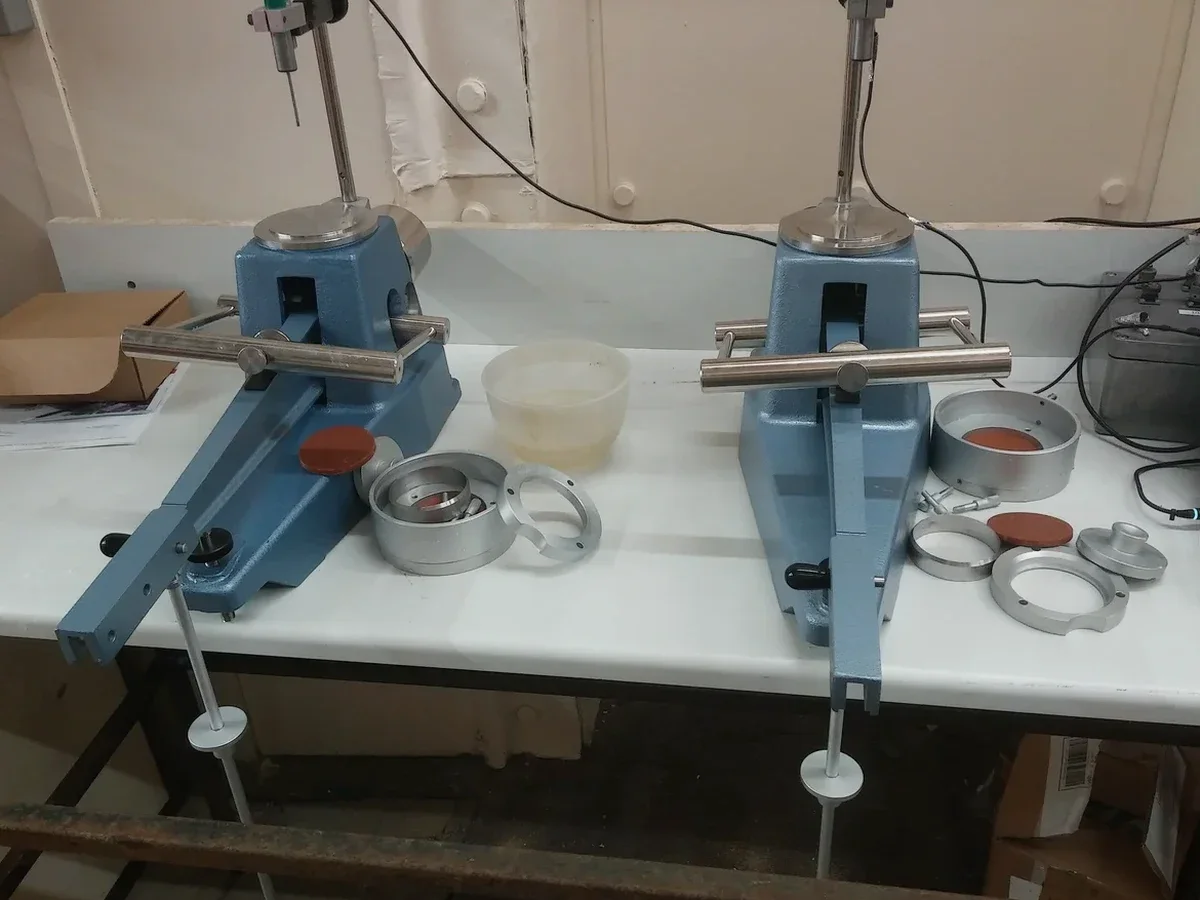
Liquid limit by Casagrande cup, plastic limit by hand-rolling, and plasticity index calculation with flow curve plotting. Includes USCS classification per ASTM D2487 and a technical memo interpreting the results for Sudbury’s typical glaciolacustrine deposits.
Combined Index Testing Suite
Atterberg limits paired with grain size distribution (sieve and hydrometer) to fully characterize the fine fraction. The combined data set supports soil identification for earthwork specifications, borrow source evaluation, and pavement subgrade rating.
Foundation Design Data Package
Atterberg results integrated with consolidation and shear strength testing to provide the complete parameter set required for shallow and deep foundation design. Includes correlations between plasticity index and compression index for settlement estimates in compressible silts.
Typical parameters
Frequently asked questions
What do Atterberg limits actually measure, and why do they matter for my Sudbury project?
Atterberg limits measure the moisture contents at which a fine-grained soil transitions between solid, semi-solid, plastic, and liquid states. The liquid limit (LL) marks the boundary between plastic and liquid behavior; the plastic limit (PL) marks the boundary between semi-solid and plastic behavior; and the plasticity index (PI = LL - PL) quantifies the range of moisture over which the soil behaves plastically. For Sudbury’s glaciolacustrine silts, these numbers determine how much water the soil can absorb before losing bearing capacity, how it will respond to compaction efforts, and whether it poses a shrink-swell risk to foundations. Without this data, a contractor risks placing fill that cannot be compacted or excavating slopes that ravel as moisture changes.
How much does Atterberg limits testing cost in Sudbury?
For a standard Atterberg limits test package (liquid limit, plastic limit, and plasticity index) on a single sample in Sudbury, the cost typically ranges from CA$90 to CA$140 depending on the number of samples, the condition of the material, and whether expedited turnaround is required. Multi-sample projects or combined testing suites with grain size analysis receive adjusted pricing. The test is performed in our accredited laboratory following ASTM D4318, and results include the flow curve, numerical limits, and USCS classification.
How long does the Atterberg limits test take from sample submission to report?
Standard turnaround is 3 to 5 business days from sample receipt. The procedure requires oven-drying to establish initial moisture content, wet preparation with a 24-hour hydration period for cohesive soils, and the actual limit determinations which involve multiple data points to construct a valid flow curve. Rush service with a 2-business-day turnaround is available for time-sensitive projects. For Sudbury sites with highly organic or unusual soils, we may recommend an extended hydration period to ensure the clay minerals reach equilibrium, which can add one additional day to the schedule.
Can Atterberg limits alone classify my soil for engineering purposes?
Atterberg limits are an essential part of the Unified Soil Classification System (USCS), but they are not sufficient on their own for a complete classification. The USCS requires both grain size distribution data (percentages of gravel, sand, and fines passing the No. 200 sieve) and the plasticity characteristics of the fine fraction. For Sudbury’s tills and varved deposits, which often contain a wide range of particle sizes, we typically pair Atterberg testing with a full sieve and hydrometer analysis to assign the correct two-letter group symbol (e.g., CL, ML, CL-ML). Organic content determination may also be recommended, as even small amounts of organics can shift the liquid limit and affect the soil’s engineering behavior.