A three-storey mixed-use building on Regent Street started showing settlement cracks within six months of completion. The culprit was uneven compaction in the glaciolacustrine silts that blanket much of the Sudbury Basin. Shallow foundation design in this city demands a reading of the terrain that goes beyond textbook assumptions. Our team has worked on footings from Garson to Lively, dealing with everything from compact ablation till to soft varved clays near Ramsey Lake. The approach combines site-specific bearing capacity calculation with settlement analysis under NBCC 2020 Part 4, ensuring the foundation matches the actual soil profile. For sites where glacial sediments transition to bedrock at shallow depth, we integrate findings from test pits to verify the refusal surface before finalizing the footing geometry.
A footing sized for 150 kPa on Sudbury till can lose 40% of its capacity if groundwater rises one meter above the base elevation.
Our approach and scope
Site-specific factors
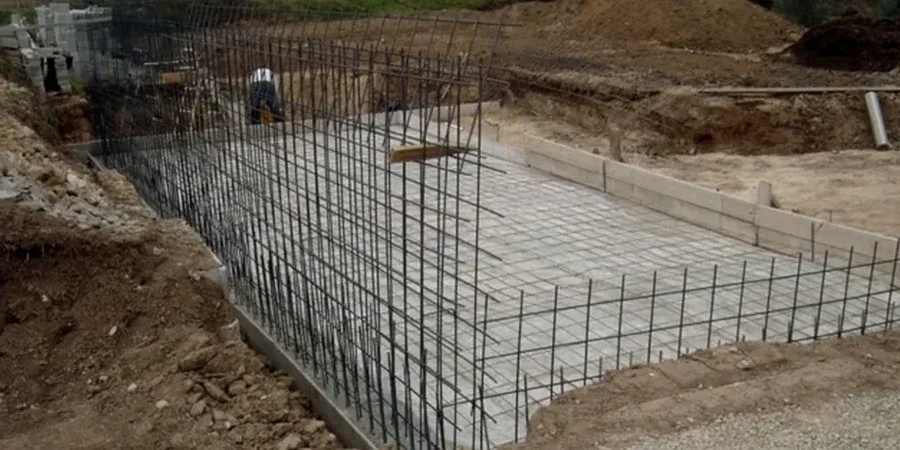
The drill rig we mobilize for shallow foundation investigation in Sudbury is a track-mounted CME-55 with automatic SPT hammer, chosen because it can access tight residential lots in the Flour Mill and West End without tearing up lawns. The operator sets up over the marked footing locations and advances hollow-stem augers through the overburden until refusal on bedrock. The real risk comes from the lens of soft, saturated silt that sits between two till layers in the southern part of the city. If that lens is missed, the footing design will be unconservative and settlement will exceed predictions. We sample every 1.5 meters and log moisture changes in real time. When the groundwater table is perched above the bearing stratum, we recommend a mudmat or gravel working platform to prevent softening during excavation and rebar installation.
Reference standards
NBCC 2020 Part 4 – Structural Design (foundation provisions), CSA A23.3:19 – Design of Concrete Structures (footing reinforcement), ASTM D1194 – Standard Test Method for Bearing Capacity of Soil (Plate Load Test correlation), OPSS.MUNI 206 – Grading and Excavation (Ontario Provincial Standard)
Complementary services
Bearing Capacity and Settlement Analysis
We calculate allowable bearing pressure using limit equilibrium methods and estimate immediate and consolidation settlement based on laboratory consolidation tests. Deliverables include a stamped foundation design brief with footing dimensions, reinforcement schedules, and subgrade preparation specs compliant with NBCC 2020 and CSA A23.3.
Footing Inspection and Subgrade Verification
During construction, our engineers inspect footing excavations to confirm the bearing stratum matches the design assumptions. We perform hand penetrometer tests and visual classification at the base of each excavation, issuing a field report within 24 hours so the concrete pour stays on schedule.
Typical parameters
Frequently asked questions
What does shallow foundation design cost for a typical Sudbury residential project?
For a single-family home or small commercial building in Sudbury, shallow foundation design including site investigation, laboratory testing, and the stamped engineering report typically ranges from CA$2,280 to CA$4,240. The final fee depends on the number of boreholes required and whether bedrock is encountered within the drilling depth.
How deep do footings need to be in Sudbury to avoid frost heave?
The NBCC 2020 specifies a frost penetration depth of 1.8 meters for the Sudbury area. Exterior strip and pad footings must bear at least 1.8 meters below finished grade unless they are founded on clean granular material or bedrock. Interior footings within heated spaces can be shallower, typically 1.2 meters, provided the building envelope maintains positive heat during winter months.
Can you design a shallow foundation if bedrock is only 1 meter below the surface?
Yes, and it is actually quite common in parts of Sudbury like the South End and Copper Cliff where the overburden is thin. We design the footing to bear directly on competent bedrock after removing any weathered or fractured surface material. The key step is confirming the rock quality through core drilling or test pit inspection so we can specify the allowable bearing pressure, which often exceeds 500 kPa for fresh norite or granite.
What happens if the soil investigation finds soft clay under my building site?
If our boreholes encounter soft, compressible clay within the zone of influence below the footings, we evaluate whether the anticipated settlement exceeds the NBCC limit of 25 mm. If it does, we may recommend a mat foundation to distribute the load, preloading with surcharge to accelerate consolidation, or a switch to a deep foundation system. The recommendation is always backed by consolidation test data from our laboratory.